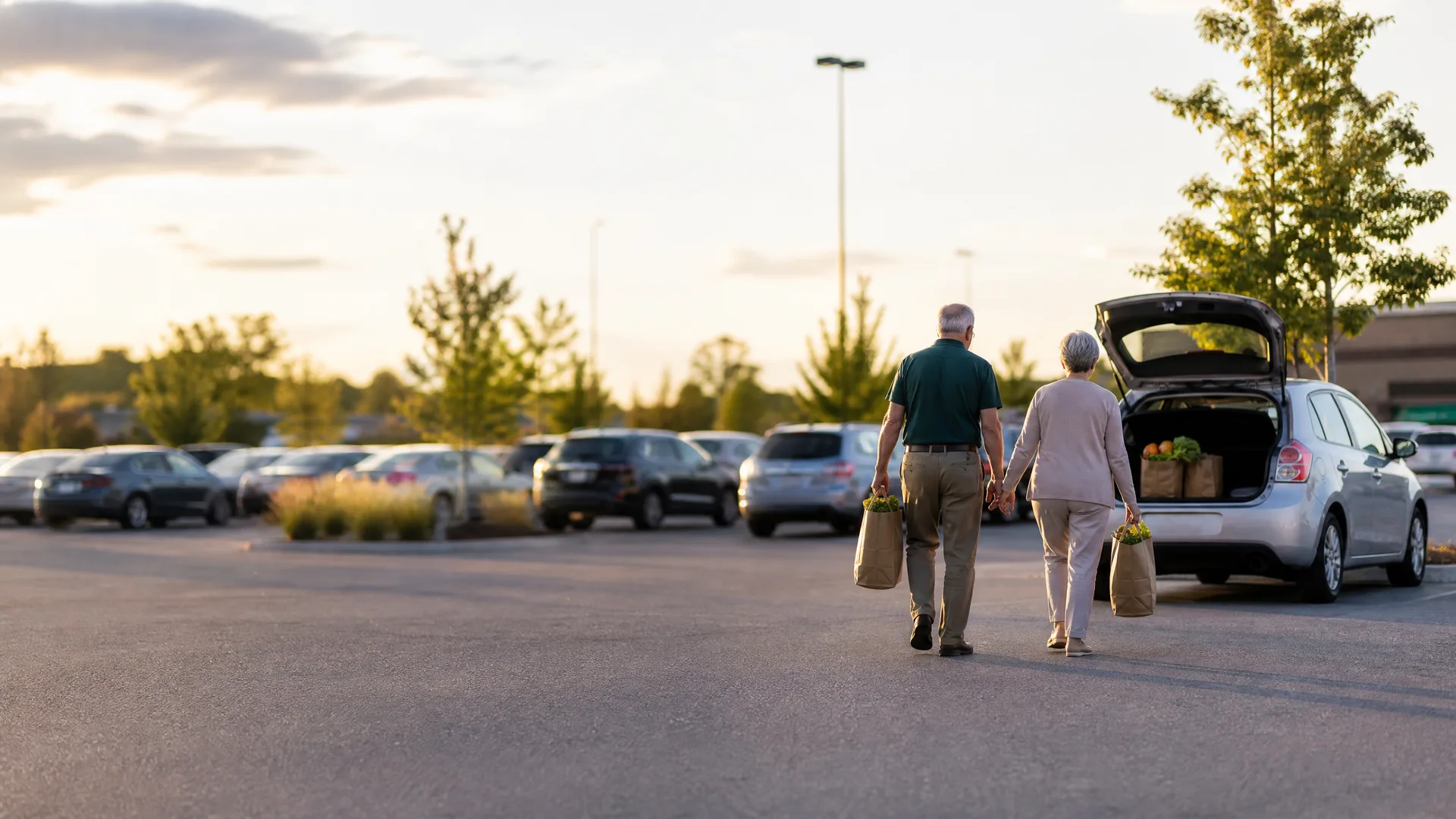
Senior Driver Car Insurance in Utah: What Changes After 65
Compare Auto Rates for Senior DriversHow Utah Car Insurance Rates Change for Senior Drivers
Utah insurers typically begin applying age-based rate adjustments around age 70, slightly later than neighboring states like Colorado or Idaho where increases often start at 65. Between ages 70 and 80, premiums for the same coverage can rise 15-25% even with no accidents or violations, according to rate filings reviewed by the Utah Insurance Department. The increases reflect actuarial tables showing higher claim frequencies in older age groups, but they're applied regardless of your individual driving record.
The average Utah senior driver aged 65-69 pays approximately $85-$110/mo for full coverage on a paid-off sedan, while the same driver at age 75-79 typically pays $100-$135/mo for identical coverage. These figures assume a clean record, 7,500 annual miles, and standard liability limits of 25/65/15 — Utah's state minimums. If you're carrying higher liability limits or comprehensive coverage on a newer vehicle, monthly costs range from $120-$180/mo depending on your specific ZIP code and carrier.
Utah's relatively modest senior rate increases compared to other states stem partly from the state's lower overall claim costs and partly from demographic factors — the state has a higher proportion of multi-generational households where seniors may drive less frequently. However, individual carriers vary significantly: some apply age adjustments as early as 65, while others wait until 72 or even 75. This variation makes carrier comparison particularly valuable as you age.

Utah's Mature Driver Course Discount and How to Claim It
Utah law doesn't mandate that insurers offer a mature driver discount, but most major carriers operating in the state voluntarily provide premium reductions of 5-10% for seniors who complete an approved defensive driving course. The catch: you must request the discount and provide proof of completion — carriers won't automatically apply it at renewal even if you're eligible. This oversight costs the average qualifying Utah senior $150-$300 annually in unnecessary premiums.
Approved courses in Utah include AARP Smart Driver (online or classroom, approximately $25 for members, $30 for non-members), AAA's Roadwise Driver program, and the National Safety Council's Defensive Driving Course. Most courses run 4-8 hours and can be completed entirely online. Upon completion, you'll receive a certificate valid for three years. Submit this certificate to your insurer within 30 days to activate the discount, which typically applies for the full three-year period before you need to retake the course.
The Utah Department of Public Safety maintains a list of approved course providers, though it's not always current. When selecting a course, confirm directly with your insurance carrier that they accept that specific provider's certificate. Some carriers only honor certain programs, and taking an unapproved course means you've spent the time and fee without gaining the discount. The discount applies to both liability and comprehensive coverage, so the savings scale with your total premium — drivers paying $140/mo can save $168-$336 over three years from a single $25-$30 course investment.

Coverage Decisions for Seniors with Paid-Off Vehicles
Most Utah seniors over 65 own their vehicles outright, eliminating the lender requirement for comprehensive and collision coverage. This creates a genuine decision point: whether the annual cost of these coverages exceeds the realistic payout you'd receive after deductible. For a 2015 Honda Accord worth approximately $12,000, comprehensive and collision coverage might cost $40-$55/mo ($480-$660/year) with a $500 deductible. If the vehicle's value drops below $5,000-$6,000, many financial advisors suggest dropping collision while retaining comprehensive, which covers theft, vandalism, weather damage, and animal strikes at significantly lower cost.
However, this calculation changes if you couldn't afford to replace the vehicle out-of-pocket after a total loss. A senior on a fixed income with $15,000 in accessible savings might reasonably keep full coverage on a $10,000 vehicle because losing that asset would eliminate transportation independence. The question isn't whether the coverage is "worth it" mathematically — it's whether you have the financial reserves to self-insure that risk. If not, maintaining comprehensive coverage provides essential protection even on older vehicles.
What virtually no Utah senior should drop is liability coverage above the state minimum. Utah's 25/65/15 minimums ($25,000 per person injury, $65,000 per accident, $15,000 property damage) fall dangerously short of modern medical costs and vehicle values. A single serious accident where you're at fault could result in a judgment exceeding your coverage by $100,000 or more, putting retirement savings and home equity at risk. Increasing to 100/300/100 limits typically adds only $15-$30/mo but provides substantially better asset protection for seniors with accumulated wealth to defend.
Medical Payments Coverage and Medicare Coordination
Utah seniors face a specific coverage question most younger drivers never consider: whether medical payments coverage duplicates Medicare benefits or fills important gaps. Medical payments coverage (often called MedPay) pays medical expenses after an auto accident regardless of fault, typically in amounts from $1,000 to $10,000. In Utah, this coverage costs approximately $3-$8/mo for $5,000 in protection, making it one of the least expensive optional coverages available.
Medicare Part B covers accident-related injuries, but it applies only after your auto insurance medical payments coverage is exhausted — a coordination rule that makes MedPay primary. This means if you have $5,000 in MedPay and $8,000 in accident-related medical bills, your auto insurance pays the first $5,000 and Medicare covers the remaining $3,000 (subject to Part B deductibles and coinsurance). Without MedPay, Medicare would cover the full amount, but you'd pay Part B's 20% coinsurance on the entire bill — $1,600 on an $8,000 claim versus $600 with MedPay covering the first $5,000.
MedPay also covers Medicare deductibles and copays that Medicare doesn't reimburse, pays for ambulance transport that Medicare may only partially cover, and extends to passengers in your vehicle who may not have health insurance. For Utah seniors, particularly those who frequently transport grandchildren or other passengers, maintaining $5,000-$10,000 in medical payments coverage provides gap protection for $40-$95 annually — often less than a single emergency room copay.
Put These Answers to Work on Your Rate
Compare Auto Rates for Senior Drivers
Low Mileage and Usage-Based Programs for Retired Drivers
Utah seniors who've retired often drive 40-60% fewer miles annually than they did while working, but many continue paying premiums calculated for 12,000-15,000 annual miles. Most major carriers now offer low-mileage discounts starting around 7,500 annual miles, with savings of 5-15% depending on how far below average your actual driving falls. However, these discounts require you to report your reduced mileage — insurers won't adjust your rate based on assumptions.
Usage-based insurance programs (Progressive Snapshot, State Farm Drive Safe & Save, Nationwide SmartRide) can deliver even larger savings for seniors with genuinely low mileage and safe driving patterns. These programs monitor actual driving through a smartphone app or plug-in device, measuring miles driven, time of day, hard braking events, and sometimes speed. Utah seniors who drive primarily during daylight hours, avoid rush-hour traffic, and drive fewer than 6,000 miles annually often see discounts of 15-30% — savings of $25-$50/mo for drivers paying $120-$150/mo for full coverage.
The privacy consideration is real: these programs collect detailed driving data including routes, times, and specific behaviors. Some seniors find this intrusive; others view it as a fair exchange for significant premium reductions. Most programs offer a trial period where you can see your projected discount before committing. If your initial trial suggests minimal savings, you can typically opt out without penalty. For Utah seniors who split time between in-state residence and winter stays in Arizona or other locations, verify that the program covers out-of-state driving — some apply higher rates or penalties for extended out-of-network driving.
Utah License Renewal Requirements for Senior Drivers
Utah requires license renewal every five years for all drivers, with no special senior provisions or testing requirements until age 65. At 65 and older, Utah drivers must renew in person rather than online, and the renewal cycle shortens to every five years with an in-person renewal required each time. The Utah Driver License Division may require a vision test at any age if there's reason to question visual acuity, but routine vision testing isn't mandatory for seniors with no documented concerns.
This in-person requirement exists primarily to allow staff to observe general cognitive function and physical capability, though Utah doesn't mandate road tests or written exams for seniors unless specific concerns arise. Family members, physicians, or law enforcement can submit a Request for Driver Review if they have safety concerns about a specific driver, which may trigger additional testing regardless of age. These reviews are confidential and focus on whether the driver can safely operate a vehicle under current conditions.
Insurance companies don't have direct access to license renewal records, but a lapsed license creates coverage problems. If your license expires and you continue driving, your insurance policy may deny claims from accidents that occur during the period your license wasn't valid. Utah law allows a 30-day grace period after expiration before penalties apply, but insurance policy language often contains no such grace period — a claim filed the day after your license expires may be denied on the grounds that you weren't legally licensed. Set a renewal reminder 60 days before expiration to avoid this gap.
How Violations and Accidents Affect Senior Driver Rates in Utah
Utah insurers typically apply surcharges for at-fault accidents and moving violations for three to five years from the incident date, regardless of your age when the violation occurred. A single at-fault accident with $3,000 or more in claims can increase premiums by 20-40% — adding $20-$50/mo to a senior's insurance costs. A speeding ticket 15+ mph over the limit typically adds 15-25% to premiums. These surcharges stack: a senior with both an at-fault accident and a speeding violation within the lookback period might see combined increases of 35-60%.
The financial impact intensifies for seniors because the surcharge applies to an already age-adjusted base rate. A 68-year-old Utah driver who pays $95/mo might see that rise to $130-$150/mo after a single at-fault accident — an annual increase of $420-$660. For seniors on fixed incomes, these increases often trigger desperate rate shopping, but the accident follows you to any new carrier through the Comprehensive Loss Underwriting Exchange (CLUE) database, which all major insurers consult.
Two strategies can mitigate rate impacts: First, if you have accident forgiveness as an optional coverage or loyalty benefit, your first at-fault accident won't trigger a surcharge. This feature typically costs $3-$8/mo but can save hundreds annually if you need it. Second, completing a defensive driving course after a violation may reduce or eliminate the surcharge with some carriers, separate from the mature driver discount. Contact your carrier within 30 days of the violation to ask specifically about remedial course options — waiting until renewal often eliminates this opportunity.
Frequently Asked Questions
Does Utah require a road test for senior drivers to renew their license?
No, Utah doesn't require routine road tests for seniors at any age. Drivers 65 and older must renew in person every five years, but additional testing only occurs if the Driver License Division or a physician submits a specific safety concern about an individual driver's capability.
Will my car insurance automatically decrease when I retire and drive less?
No, you must contact your insurer and report your reduced annual mileage to receive a low-mileage discount. Most Utah carriers offer 5-15% discounts for seniors driving under 7,500 miles annually, but they won't apply this adjustment unless you specifically request it and verify your mileage.
Can I drop comprehensive coverage on my paid-off car in Utah?
Yes, Utah doesn't require comprehensive or collision coverage once your vehicle is paid off. However, this is only financially prudent if you have sufficient savings to replace the vehicle out-of-pocket after a total loss — if losing the car would eliminate your transportation independence, keeping comprehensive coverage may be the safer choice even on older vehicles.
How much does the AARP mature driver course save on Utah car insurance?
Most Utah carriers offer 5-10% premium reductions for seniors who complete an approved mature driver course like AARP Smart Driver. For a senior paying $120/mo, this translates to $72-$144 in annual savings for a course that costs $25-$30 and remains valid for three years.
Does Medicare cover car accident injuries or do I need medical payments coverage?
Medicare Part B does cover auto accident injuries, but it applies only after your auto insurance medical payments coverage is exhausted. Medical payments coverage acts as primary and also covers Medicare's deductibles and copays, typically costing Utah seniors only $3-$8/mo for $5,000 in protection.
Related Articles

Van & SUV Insurance for Seniors: Rates After 65
4/11/2026

NJ Mature Driver Certificate: How to Apply
6/11/2026

Car Insurance for Seniors Driving Occasionally
4/11/2026
CT Senior Driver Insurance: Rates, Discounts & Coverage
4/7/2026

Alabama Senior Driver Insurance: Rates & Coverage After 65
4/7/2026

When Should Senior Drivers Stop? Insurance Signals
4/11/2026