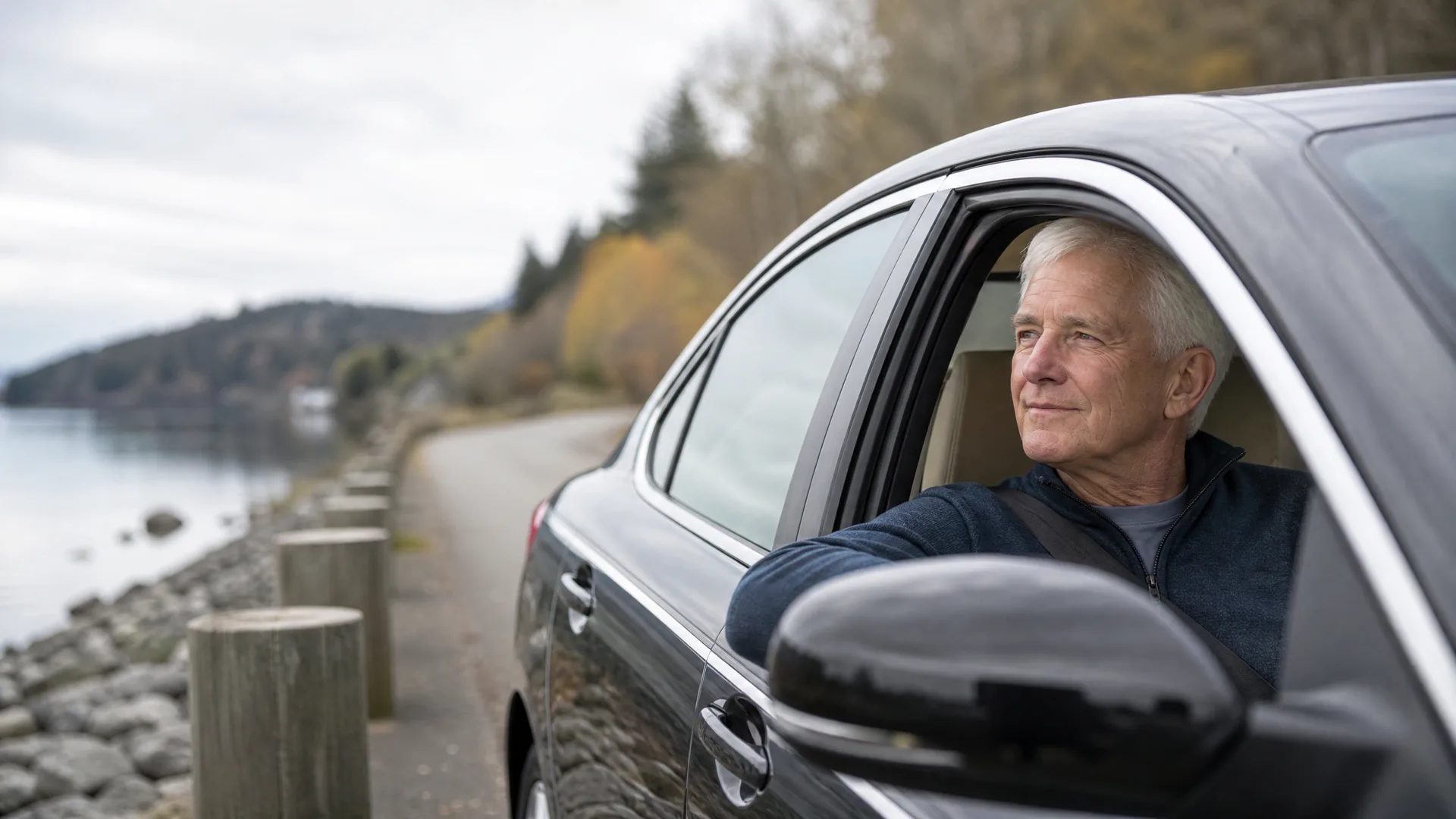
Senior Driver License Renewal Requirements by State
Compare Auto Rates for Senior DriversHow License Renewal Rules Change After Age 65
Twenty-nine states impose age-specific license renewal requirements that take effect at 65, 70, or 75, according to the AAA Foundation for Traffic Safety. These aren't suggestions — they're mandatory conditions that determine whether you can renew online, by mail, or must appear in person at a DMV office. The most common changes include mandatory vision testing, elimination of online/mail renewal options, and shortened renewal cycles that require you to renew every 2-4 years instead of the standard 6-8 year cycle younger drivers receive.
The trigger age varies significantly. Illinois requires in-person renewal starting at age 75 with a road test for drivers 87 and older. California eliminates mail and online renewal at age 70, requiring all seniors to appear in person. Arizona requires vision testing every renewal cycle starting at age 65, but still allows online renewal if you pass. Florida shortens the renewal cycle to every six years at age 80, down from eight years for younger drivers.
These requirements exist independently of your driving record. A 72-year-old California driver with a spotless 50-year history faces the same in-person requirement as someone with recent violations. The rationale is age-based screening, not individual performance — a policy framework that doesn't account for the fact that drivers aged 65-74 have lower crash rates per mile than drivers under 25, according to Insurance Institute for Highway Safety data.
The financial impact is indirect but real. In-person renewals mean scheduling appointments during business hours, arranging transportation if you no longer drive comfortably to unfamiliar locations, and potentially paying for vision exams that weren't required at your last renewal. For drivers on fixed incomes, a $75 vision exam and half a day's planning represents a cost younger drivers avoid entirely.

States With the Strictest Senior Renewal Requirements
Illinois operates the most comprehensive age-based renewal system in the country. Starting at age 75, all drivers must renew in person. At age 81, renewal cycles drop to two years. At age 87, drivers must complete a driving test at every renewal — meaning a road test every two years as long as you maintain a license, according to the Illinois Secretary of State.
California requires in-person renewal for all drivers 70 and older, eliminating the online and mail options available to younger drivers. The state also requires vision testing at every renewal, though the test is administered at the DMV during your appointment rather than requiring a separate eye doctor visit. New Hampshire takes a similar approach, requiring vision testing for all renewals after age 75.
Florida, Iowa, and Oregon all shorten renewal cycles for older drivers. Florida drops from eight years to six years at age 80. Iowa moves to a two-year cycle at age 72, and Oregon requires in-person renewal with vision testing every four years starting at age 50 — one of the earliest trigger ages in the country. These shortened cycles mean more frequent renewals, more appointments, and higher cumulative fees over a decade of driving.
Nine states — Arizona, California, Georgia, Illinois, Indiana, Kansas, Maine, New Mexico, and Utah — specifically require vision testing at renewal for drivers over certain ages, according to the National Highway Traffic Safety Administration. The testing standards vary: some states require 20/40 vision in at least one eye, while others allow corrective lenses to meet the threshold. If you fail the vision test, you may need a statement from an eye care professional before the DMV will issue a renewal.


States With No Age-Based Renewal Requirements
Twenty-one states impose no additional license renewal requirements based on age. In these states, a 75-year-old driver renews under the same rules as a 35-year-old: same renewal cycle, same testing (or lack thereof), same online and mail options. These states include Alabama, Alaska, Arkansas, Connecticut, Delaware, Hawaii, Kentucky, Massachusetts, Michigan, Minnesota, Mississippi, Nebraska, New York, North Carolina, Ohio, Pennsylvania, South Carolina, Tennessee, Texas, Washington, and Wisconsin.
This doesn't mean renewal is automatic. All drivers in these states must still meet standard vision requirements, pass knowledge tests if renewing after extended lapses, and comply with federal REAL ID requirements if they want a compliant license for air travel. But age itself triggers no additional hurdles.
The lack of age-based requirements reflects different policy approaches to senior driver safety. Some states focus on incident-based review — meaning your license faces scrutiny after a crash or violation, not because of your birthdate. Others rely on family reporting, medical provider notifications, or self-regulation. Massachusetts, for example, allows family members and physicians to request driver re-evaluations at any age, shifting responsibility from blanket age rules to individual capacity assessments.
For senior drivers in these states, the renewal process remains consistent across decades. You receive a renewal notice 30-60 days before expiration, renew online or by mail if you meet standard requirements, and receive a new license valid for the state's standard term — typically 5-8 years. The continuity matters particularly for drivers managing multiple state transitions: moving from Ohio to Illinois at age 74 means encountering in-person requirements for the first time in 50 years of driving.
How Medical Conditions Interact With State Renewal Rules
State DMV agencies operate separate medical review processes that can override standard renewal procedures at any age. If you've been diagnosed with certain conditions — epilepsy, severe diabetes, dementia, vision loss, or cardiovascular conditions that cause loss of consciousness — your doctor may be required or permitted to report this to the DMV depending on state law. Currently, six states mandate physician reporting of specific diagnoses: California, Delaware, Nevada, New Jersey, Oregon, and Pennsylvania.
Once a medical report reaches the DMV, most states initiate a medical review that can include requiring a physician's statement, a driving evaluation, restricted licensing (daylight only, local radius only), or license suspension pending medical clearance. This process runs parallel to age-based renewal rules, meaning a 72-year-old California driver already required to renew in person may also face a medical review if their physician reports a qualifying condition.
Some conditions trigger automatic license restrictions rather than suspension. Drivers with controlled epilepsy, for example, may receive a license valid only if they remain seizure-free for a specified period — typically 6-12 months depending on the state. Diabetes requiring insulin may require annual medical certification in some states. Vision loss below state thresholds may result in daylight-only or speed-restricted licenses rather than full revocation.
The intersection with insurance is significant. Many carriers require you to report license restrictions or suspensions, and failing to do so can void coverage. If your state DMV imposes a daylight-only restriction and you don't notify your insurer, a claim filed after an evening crash could be denied for material misrepresentation. Liability insurance doesn't protect you if you're driving outside the conditions of your restricted license — you're effectively uninsured even if you're paying premiums.

Put These Answers to Work on Your Rate
Compare Auto Rates for Senior Drivers
How to Prepare for Your State's Renewal Requirements
Start by checking your state's specific requirements 90 days before your license expires, not when you receive the renewal notice. Most state DMV websites include age-specific renewal instructions — search "[your state] DMV senior license renewal" to find the relevant page. If your state requires in-person renewal, DMV appointment availability can stretch 3-6 weeks in urban counties, and waiting until you receive your notice may leave insufficient time to schedule before expiration.
If your state requires vision testing, schedule an eye exam with your regular eye care provider before heading to the DMV. While most DMVs offer basic vision screening on-site, failing that test means leaving without a renewal and returning after seeing an eye doctor. Having current prescription glasses or contacts and a recent eye exam report gives you documentation if the DMV screening is borderline. Vision standards are typically 20/40 in at least one eye, corrected or uncorrected.
Gather required documentation before your appointment. All states now offer REAL ID-compliant licenses, which require proof of identity (passport or birth certificate), Social Security number, and two proofs of residency (utility bills, mortgage statements, vehicle registration). Even if you've held a license in your state for 40 years, REAL ID upgrades require this documentation. Arriving without it means a wasted trip and rescheduling.
If your state requires knowledge testing for seniors, most DMV websites offer practice tests that mirror the actual exam format. The tests typically cover road signs, right-of-way rules, and state-specific traffic laws. Some states haven't updated their knowledge tests in decades — meaning the test may not reflect current road conditions but does reflect what the DMV considers essential knowledge. Reviewing your state's driver handbook the week before renewal takes 2-3 hours and significantly improves first-attempt pass rates.

How License Renewal Status Affects Your Insurance Rates
Most auto insurance policies require a valid driver's license as a condition of coverage. If your license expires and you continue driving on an expired license — even for a few days while waiting for a DMV appointment — you're driving without a valid license in the eyes of your insurance carrier. A crash during that period can result in claim denial, policy cancellation, and personal liability for all damages.
Carriers verify license status at policy inception, renewal, and after claims. If you don't renew your license within your state's grace period (typically 30-60 days after expiration), your insurer may non-renew your policy at the next renewal or cancel mid-term if discovered. Non-renewal for license issues creates a gap in coverage history, which raises rates with future carriers — typically 10-20% higher than continuous coverage rates.
Some senior drivers reduce coverage or drop insurance entirely when they stop driving regularly, assuming they can reinstate later if needed. This creates a coverage gap that's visible to all future insurers. After a gap of 30 days or more, most carriers classify you as a higher-risk driver regardless of your prior history. The industry term is "prior insurance discount" — and losing it can add $200-400 annually to premiums even if you have a clean driving record.
If you're required to complete a state-mandated medical review or road test as part of license renewal, inform your insurance agent before the review. Some carriers offer mature driver discounts for completing accredited defensive driving courses, which can offset rate increases and demonstrate your commitment to safe driving. AARP and AAA both offer state-approved courses that qualify for discounts with most major carriers — typically 5-10% off premiums for 3 years after course completion.
When to Consider Voluntary License Surrender
Voluntary license surrender is a personal and family decision that some senior drivers face when medical conditions, vision changes, or cognitive decline make driving unsafe — even if the state hasn't mandated surrender. The decision carries financial and insurance implications beyond mobility.
If you surrender your license voluntarily, notify your auto insurer immediately. You cannot legally maintain auto insurance as a primary driver without a valid license. However, if you own a vehicle that other licensed household members drive, you may be listed as an excluded driver, allowing the vehicle to remain insured. Some states allow non-driver insurance policies for vehicle owners who don't drive but want coverage for others using their vehicle.
Surrendering your license doesn't eliminate your need for medical coverage after auto crashes. Medicare covers injuries from car crashes just as it covers other medical expenses, but it doesn't cover damages you cause to others. If you're a passenger in a crash, the driver's insurance typically provides primary coverage — but if that coverage is insufficient, you could face out-of-pocket costs. Some senior drivers maintain medical payments coverage even after surrendering their licenses, listing themselves as excluded drivers but maintaining coverage as passengers.
The timing of voluntary surrender matters for future reinstatement. Most states allow license reinstatement after voluntary surrender if you can pass all standard testing requirements. However, some states treat voluntary surrender after a certain age differently — requiring full retesting including written, vision, and road tests rather than simple renewal. If there's any possibility you might drive again, consult with your state DMV about the reinstatement requirements before surrendering.
Frequently Asked Questions
Can I renew my driver's license online after age 70?
It depends entirely on your state. Twenty-one states allow online renewal at any age if you meet standard requirements. However, states like California, Illinois, and New Hampshire require in-person renewal starting at ages 70-75. Check your state DMV website for age-specific renewal requirements at least 90 days before your license expires.
Do senior drivers have to take a driving test to renew their license?
Most states do not require road tests for license renewal based solely on age. Illinois is the notable exception, requiring driving tests for all renewals after age 87. However, any driver at any age may be required to take a road test if the DMV receives a medical report or crash history that raises safety concerns.
What happens to my car insurance if my license expires?
Driving with an expired license — even briefly — can void your auto insurance coverage. If you're in a crash while your license is expired, your insurer may deny the claim and cancel your policy. Most states allow a 30-60 day grace period for renewal, but insurance policies typically require a valid license at all times as a condition of coverage.
Does my state require vision testing at license renewal after age 65?
Nine states require vision testing at renewal for older drivers: Arizona, California, Georgia, Illinois, Indiana, Kansas, Maine, New Mexico, and Utah. The trigger age varies from 50 to 75 depending on the state. Most states require 20/40 vision in at least one eye, with or without corrective lenses.
Can I keep my car insurance after surrendering my driver's license?
You cannot maintain insurance as a primary driver without a valid license. However, if you own a vehicle driven by other licensed household members, you can be listed as an excluded driver while keeping the vehicle insured. Some seniors also maintain medical payments coverage for injuries sustained as passengers even after surrendering their licenses.
Related Articles

Van & SUV Insurance for Seniors: Rates After 65
4/11/2026

NJ Mature Driver Certificate: How to Apply
6/11/2026

Car Insurance for Seniors Driving Occasionally
4/11/2026

CT Senior Driver Insurance: Rates, Discounts & Coverage
4/7/2026

Alabama Senior Driver Insurance: Rates & Coverage After 65
4/7/2026

When Should Senior Drivers Stop? Insurance Signals
4/11/2026